<img height="1" width="1" style="display:none" src="https://www.facebook.com/tr?id=2358479414501997&amp;ev=PageView&amp;noscript=1">

Sustainable Intermodal Walkability Index (SIWI)

FS Engineering's commitment to more accessible, sustainable and traveller-friendly stations


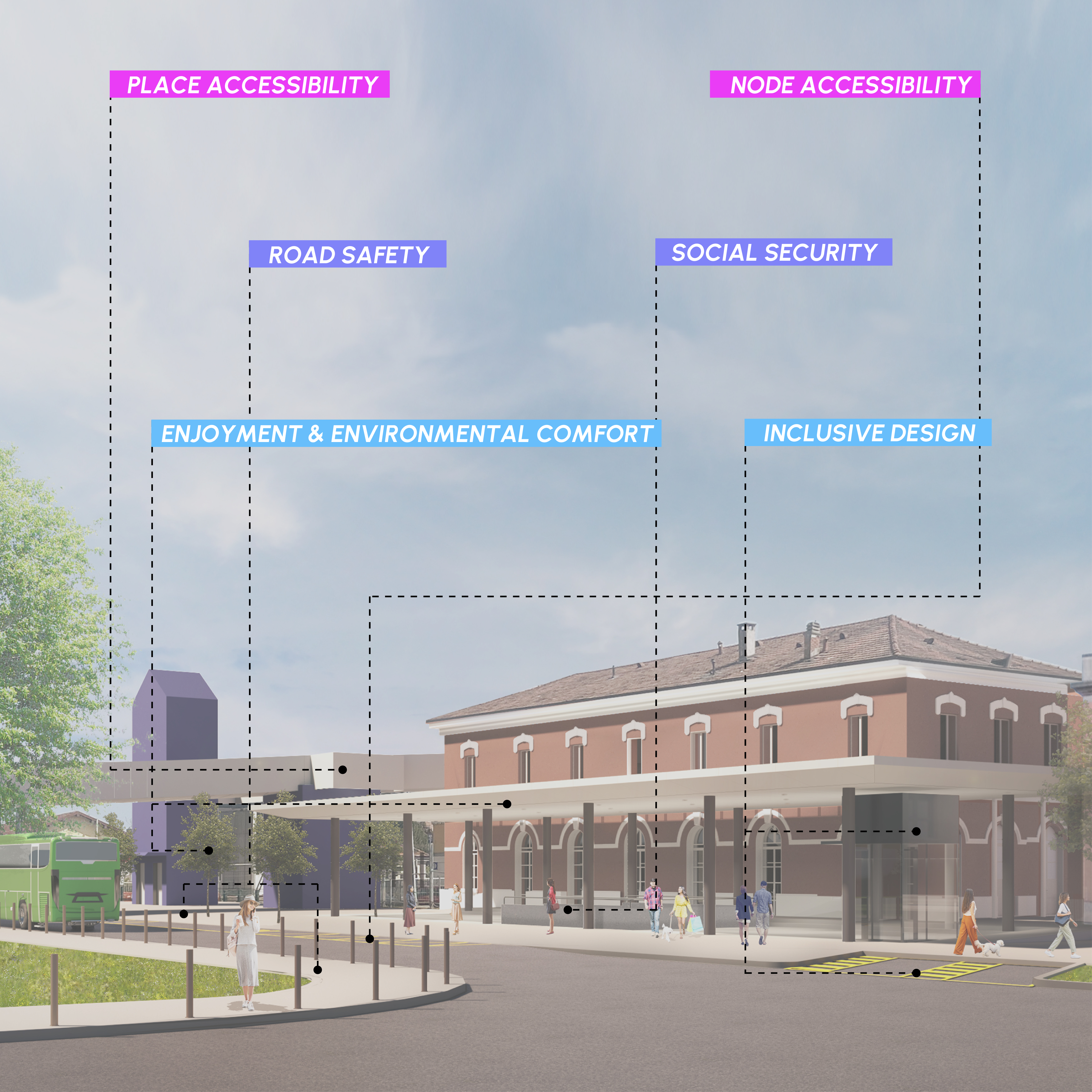
Credits: Reworking of photo insertion of the new layout of San Cristoforo station and the access area, with new canopy and redevelopment of pedestrian spaces and reorganisation of the road network in front of the station (CREW). The project shown is still in the development stage and the authorisation process has not yet begun.

Railway stations are complex urban environments. Infrastructure serving as public spaces offering public services. Collective mobility hubs generating waves of inflows and outflows. Urban focus points shaped to respond to the changing needs of everyday life, commuting and tourism.

At FS Engineering, we adopt an integrated and multidisciplinary approach to designing stations, based on a combination of functionality, spatial quality, environmental sustainability and a social dimension.

This requires evaluating the role of stations in the urban system, the quality of accessibility, the safety and comfort of routes, and the capacity to promote pedestrian and bicycle mobility and intermodality, even for the most vulnerable users, from the earliest design stages.

Ad hoc assessment methodologies and tools for developing and maintaining a structured and informed design process.

Therefore, FS Engineering, in partnership with Sapienza University of Rome, the University of Parma, the University of Cagliari and the FS Group Research Centre, has contributed to furthering applied research within the framework of Spoke 9 of the Mobility and Sustainable Transport (MOST) project dedicated to Urban Mobility, which has rolled out the Sustainable Intermodal Walkability Index (SIWI), as an operational tool for analysing accessibility, safety, spatial quality and the capacity of stations to support sustainable mobility.

The objective is threefold: to evaluate stations and enhance the characteristics of urban environments that promote and support sustainable mobility, providing concrete guidelines for urban design and transformation processes and maximising synergies between rail transport and active mobility.

Sustainable Intermodal Walkability Index (SIWI)

The Sustainable Intermodal Walkability Index – SIWI – is a design tool for measuring how stations can promote active mobility and improve urban quality, through the analysis of spaces, flow routes and the urban context, with a view to strengthening sustainable mobility by effectively integrating the different transport systems.

Assessment is based on a structured set of six key performance indicators (KPIs), which are applied to analyse stations from the point of view of the people who pass through and experience these urban spaces on a daily basis. The KPIs, by focusing on active mobility, take into account:

  • ease of access by different transport modes and interchange options
  • the level of connectivity between stations, their neighbourhoods and urban services
  • the perception of safety in the spaces and along the routes
  • overall travel safety, especially for pedestrians and cyclists
  • universal accessibility and inclusion of all categories of users
  • environmental comfort and overall user experience

At FS Engineering, we define the criteria, data sources for as-is and to-be scenarios, assessment intervals and weights for each KPI, by consulting with experts, in order to assesses how people move around the station and how they experience the space, with a focus on urban quality and people's well-being.

The SIWI tool, digitised with a dedicated web app, enables a standard, reliable and rapid assessment process for sustainable design and has been tested for integrating with the Strategic Information Monitoring System (SIMS) platform, to share data with other Group companies and create dedicated accounts for project partners, promoting informed decision-making and effective collaboration.

Milano San Cristoforo: from the development of SIWI to its application in a real case study

FS Engineering applied SIWI to the Milano San Cristoforo station, part of the complementary network managed by RFI, chosen as a case study for its strategic role in the metropolitan mobility system. Following the activation of the new M4 line, and thanks to the relevant integrated mobility services, San Cristoforo has become a transport facility with the potential to evolve into a key intermodal hub, significantly impacting urban transformation and the quality of public spaces in the area.

The station is part of the Programme Agreement (AdP) for the urban transformation of disused and decommissioned railway areas and the upgrading of the Milan rail network promoted by the Municipality of Milan, in collaboration with Ferrovie dello Stato and the Region of Lombardy. FS Engineering and CREW are tasked with upgrading the station, with a specific focus on improving the accessibility and walkability of the station's entrance and waiting areas, by means of a direct connection with the new M4 metro station.

SIWI has provided an integrated perspective of infrastructure, public space and mobility, as well as concrete support for the decision-making and design processes, and its results have highlighted the strong interconnections between the station, the metro network and mobility services, establishing Milano San Cristoforo as a replicable model of intermodal hub in a metropolitan area.


Overview

SIWI is an operational decision-making support tool, useful for defining priorities, monitoring projects and guiding design towards more sustainable, resilient and intermodal mobility.
By looking at stations not simply as transport infrastructure, but as an integral part of the broader urban system, FS Engineering positions itself as a key player in contributing to the European strategies for building future urban mobility, putting people and their journeys at the heart of the design process.