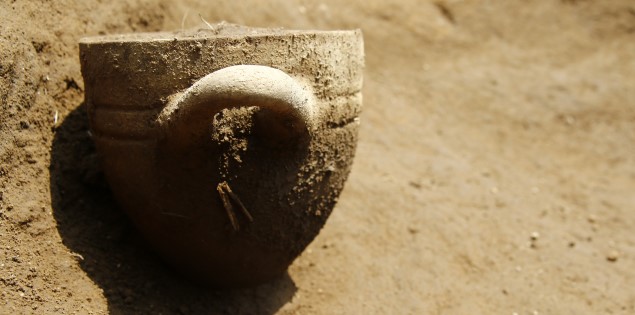
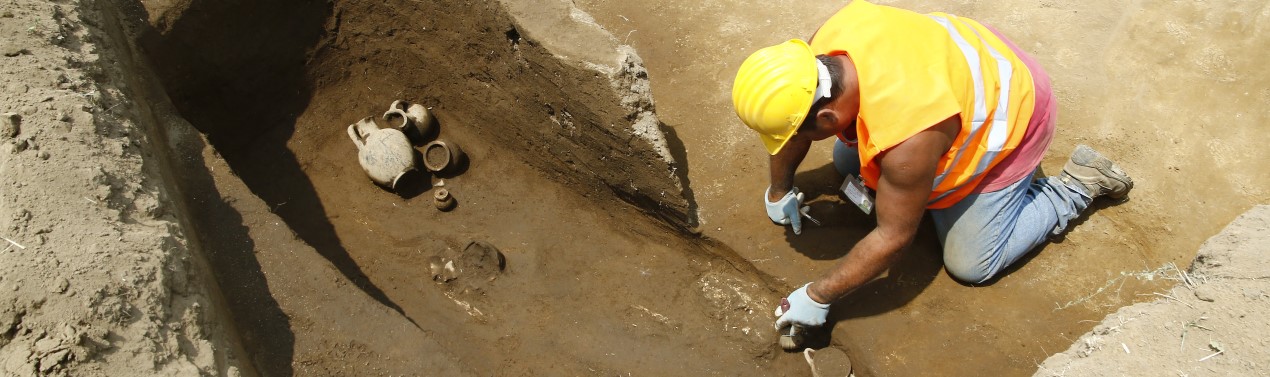
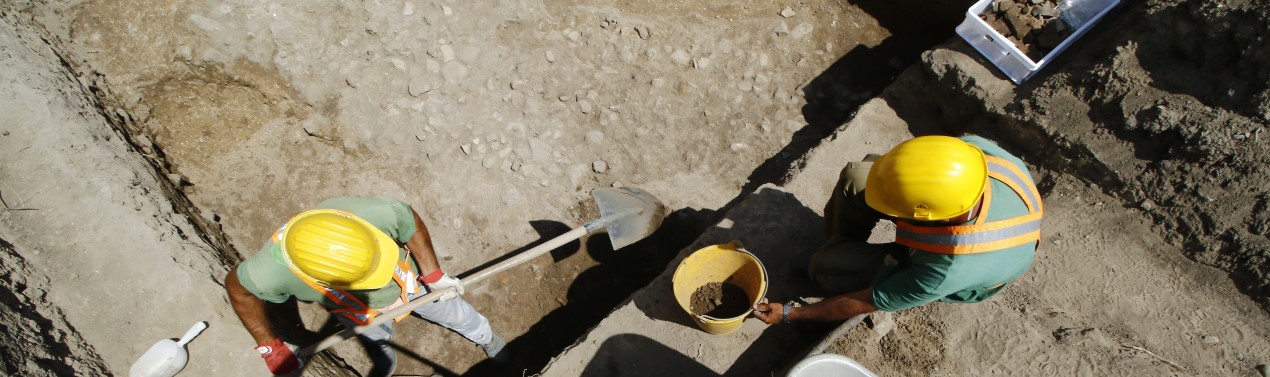
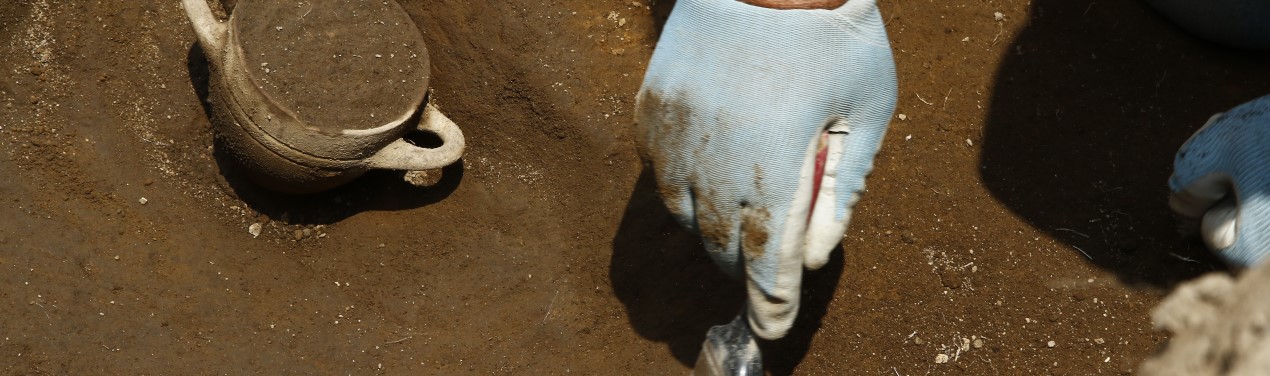
We are the first Italian engineering company to establish an in-house archaeology department, a unique specialist unit within the national landscape.
This specialised team—the only one of its kind in Italy—is responsible for the preliminary identification of archaeological remains. It determines the most effective solutions for managing conflicts between new infrastructure projects and historical-cultural heritage. Activities also encompass the enhancement of discoveries through specialist projects aimed at advancing knowledge and disseminating the history of land use.
The department operates in continuous liaison with the relevant Local Heritage Authorities and is registered on the Ministry of Culture's official list of operators certified to draft Archaeological Impact Assessments (DVA).
Furthermore, alongside Rete Ferroviaria Italiana and Anas, we are members of Archeolog, the FS Group’s non-profit organization. Working in synergy with the heritage authorities, it contributes to the restoration, conservation, and enhancement of archaeological artefacts unearthed during the construction and maintenance of Italian rail and road infrastructure.
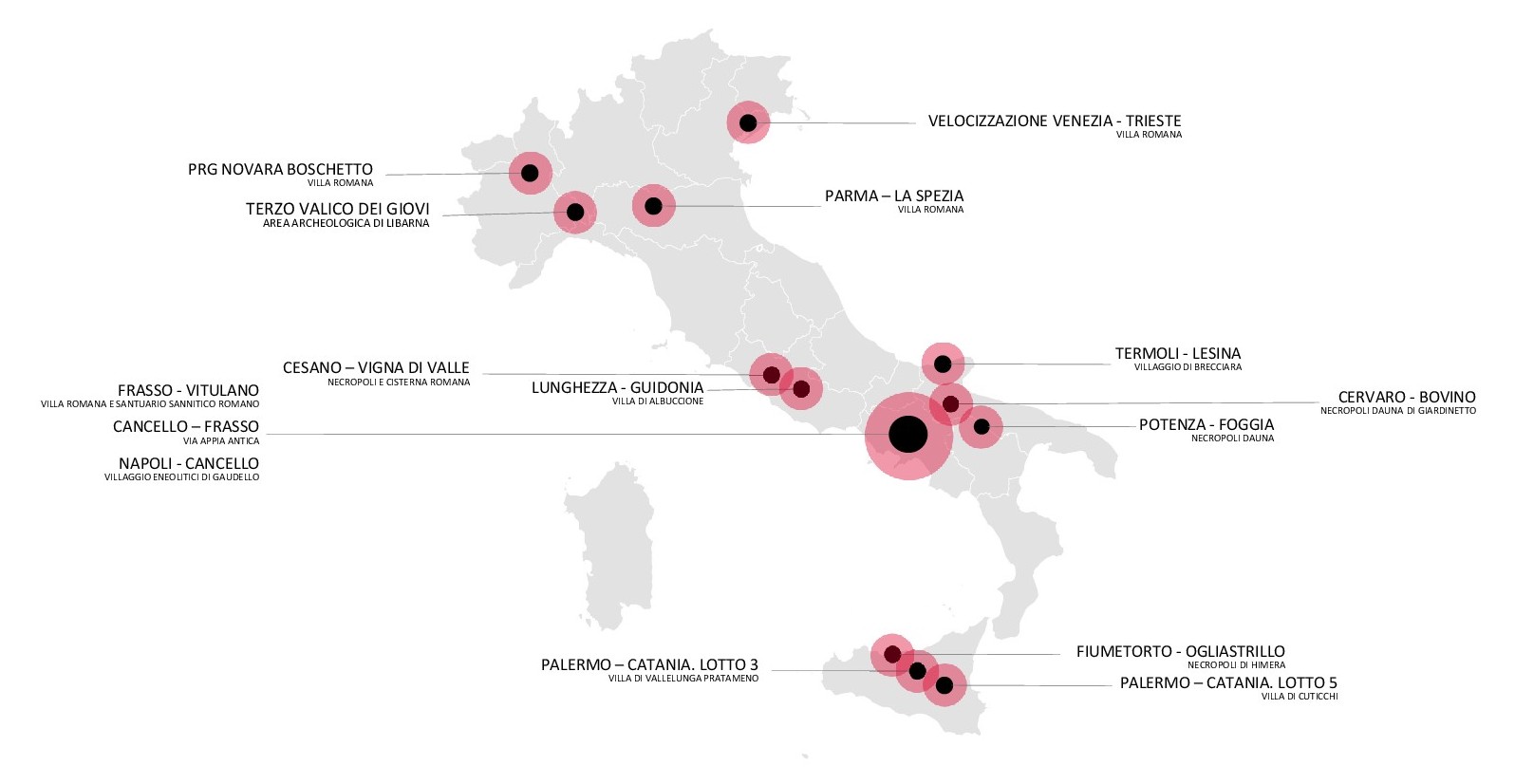
MAJOR ARCHAEOLOGICAL DISCOVERIES
LEARN MORE
FS Engineering has been actively engaged in the field of preventive archaeology since 2006, and is today the most highly structured and organised entity among Italy's major contracting authorities for drafting specialist research studies and executing archaeological investigations and excavations in support of infrastructure projects. The Company supports the entire design process, ensuring the required levels of detailed analysis and collaborating with the relevant Local Heritage Authorities to define the scope and methodology for the preliminary verification of archaeological interest.
The expertise of FS Engineering is founded upon the extensive experience gained from archaeological discoveries unearthed during the construction of High-Speed rail lines, which has contributed to the development of specialist know-how recognised at an institutional level. This has also proved decisive in defining the statutory procedure for the "Preliminary verification of archaeological interest", which was subsequently codified into Article 25 of the Public Procurement Code (Legislative Decree 50/2016, as amended).
Today, preventive archaeology represents a strategic element of project design, ensuring an informed and responsible approach to the delivery of complex infrastructure that significantly impacts the territory. Through the application of advanced technologies and non-invasive investigation methodologies, FS Engineering mitigates archaeological risk, thereby contributing to the reduction of project timelines and costs, enhancing design quality, and minimising environmental impacts.
The collaboration with universities and research centres has also fostered the development of a digital platform and the use of AI solutions for analysing large volumes of geophysical data, increasing the reliability and precision of assessments.
The benefits are tangible: more efficient planning, a reduction in unnecessary excavations, lower environmental impact, and the enhancement of cultural heritage. Preventive archaeology thus acts as an enabling factor for sustainable, innovative infrastructure that is fully integrated into the historical environment and the broader geographical context.
Archaeological studies qualify rail projects through an in-depth analysis based on specialist parameters, such as the acquisition and processing of archival and bibliographic data, the study of historical maps and placenames, aerial photointerpretation, and surface reconnaissance campaigns aimed at the direct observation of the land. These activities enable the development of a systematic mapping of documented archaeological finds within the relevant landscape, associated with specific potential risks measured against the extent of any known remains and the characteristics of the proposed works.
This integrated approach supports more informed and effective planning, aimed at protecting the archaeological heritage and the overall quality of infrastructure design.
Based on the findings of the archaeological studies, and in agreement with the relevant Local Heritage Authorities, FS Engineering develops targeted designs for the execution of geophysical surveys, geoarchaeological core drilling, exploratory trial pits and trenches, as well as open-area excavations.
Following the design phase, the Company manages the execution of the fieldwork operations. These are carried out under the supervision and technical-scientific direction of the relevant Local Heritage Authorities, with FS Engineering providing construction supervision and health and safety coordination on site.
FS Engineering oversees every aspect connected to the execution of archaeological investigations, from managing land access for the target verification areas to preliminary unexploded ordnance (UXO) clearance and site establishment.
Fieldwork operations are carried out by specialist archaeological contractors and enterprises, requiring the use of mechanical equipment, alongside a skilled workforce made up of archaeologists, surveyors, illustrators, anthropologists, geologists, and conservators. Upon completion of the site operations, FS Engineering verifies the technical and scientific documentation recording the investigation outcomes. This data is integrated into the rail project from its earliest stages, serving as the essential instrument for securing the statutory consents required before construction can begin.
This integrated approach enables the Company to achieve significant performance milestones, including more effective time and cost programming for archaeological investigations and the possibility of drastically reducing the amount of unexpected discoveries during the main construction phase.
In close coordination with the relevant Local Heritage Authorities, FS Engineering manages post-excavation activities and the enhancement of highly significant archaeological sites. This scope encompasses the study, cataloguing, and conservation of artefacts, the development of databases and GIS platforms, the preparation of scientific publications, and designing and laying out of museum spaces.
The extensive experience gained within the High-Speed sector has also enabled the Company to develop an innovative approach, grounded on new methodologies that effectively view archaeology as part and parcel of the design process, transforming rail projects into a precious opportunity for understanding, protecting, and enhancing the significant archaeological heritage of the regions concerned.
THE ROMAN VILLA AT VALLELUNGA PRATAMENO
An extraordinary Roman domus of exceptional historical and scientific value has emerged during preventive archaeological investigations conducted by FS Engineering along the Lercara–Caltanissetta Xirbi section, part of the Palermo–Catania High-Speed line doubling project.
The discovery bears witness to the wealth and continuity of settlement across the territory traversed by the new infrastructure and confirms the integrated approach adopted by FS Engineering, which places the protection and enhancement of cultural heritage at the heart of the design phases. The excavation activities, currently underway and carried out in close coordination with the relevant Local Heritage Authorities, are yielding vital insights into the ancient history of the area, transforming the railway project into an opportunity to deepen our knowledge of and showcase the local archaeological landscape.
ENEOLITHIC NECROPOLIS AND DAUNIAN SETTLEMENT
An Eneolithic cremation necropolis and significant evidence of a Daunian settlement have emerged during preventive archaeological investigations conducted by FS Engineering for the new Naples–Bari rail link. The discovery was made during track-duplication works on the Bovino–Cervaro section at the Giardinetto site, located within the municipality of Orsara di Puglia in the province of Foggia.
The archaeological complex, comprising burial clusters and the remains of residential structures, represents an exceptionally significant resource for reconstructing the earliest phases of land occupation and its evolution over time. Conducted in close coordination with the relevant Local Heritage Authorities, these activities confirm FS Engineering’s integrated approach, which pairs major infrastructure delivery with the protection, understanding, and enhancement of cultural heritage, thereby transforming the railway project into an opportunity for historical research and insight for the regions traversed.
THE NECROPOLIS OF HIMERA, ONE OF EUROPE’S MOST SIGNIFICANT ARCHAEOLOGICAL SITES
One of the most consequential archaeological excavations in Europe was carried out during track-duplication works for the Fiumetorto–Cefalù–Ogliastrillo section of the Palermo–Messina line, which entered service in 2017. Over 20,000 archaeological artefacts were unearthed during the investigations, presenting a picture of exceptional historical and scientific value tied to the necropolis of the ancient city of Himera.
The excavation activities were conducted under the construction supervision of FS Engineering, working in close coordination with the relevant Local Heritage Authorities. This integrated approach successfully balanced the delivery of the rail infrastructure with the protection, study, and enhancement of an extraordinarily important archaeological heritage. It stands as an emblematic project, demonstrating how major works can be transformed into a unique opportunity to expand our knowledge of and deepen historical insight into the regions they traverse.
SANCTUARY OF PONTE
An important sanctuary dating to the Hellenistic-Roman period, characterised by an extraordinary concentration of votive offerings, has been discovered in the municipality of Ponte, in the province of Benevento. The find was made during preventive archaeological investigations conducted by FS Engineering as part of track-duplication works on the Telese–Vitulano section of the new Naples–Bari HS/HC line.
The archaeological complex presents a picture of immense historical and religious importance. The unearthed artefacts include depictions of deities associated with initiation rites, statuettes of young female devotees and warriors, a terracotta model of a miniature temple designed for collecting offerings, anatomical ex-votos, small bronzes, coins, pottery lamps, and ceramics.
The discovery bears witness to the religious site's central role as a place of worship and ritual gathering, and confirms the integrated approach adopted by FS Engineering, which recognizes archaeology as a strategic asset in the design process. From this perspective, the railway project becomes a concrete opportunity for understanding, protecting, and enhancing the archaeological heritage of the regions traversed, working in close coordination with the relevant Local Heritage Authorities.
IMPERIAL ROMAN SETTLEMENT
A vast necropolis dating to the Roman Imperial period, situated on a hill overlooking the Dittaino River—known as Chrysas in ancient times—has been identified during preventive archaeological investigations conducted by FS Engineering along the Palomba–Catenanuova section of the Palermo–Catania rail link.
The discovery comprises a significant cluster of monumental burials, which unequivocally attest to the high level of wealth and the socio-economic importance of the ancient settlement that emerged in the area. The excavation, currently underway and conducted in close coordination with the relevant Local Heritage Authorities, are yielding valuable data for reconstructing the settlement and the contemporary landscape setting.
The intervention confirms the integrated approach adopted by FS Engineering, which combines the delivery of rail infrastructure with the protection, understanding, and enhancement of cultural heritage, thereby transforming the railway project into an opportunity for historical and cultural research for the regions traversed.