Life in the Tunnels
Impressions, perceptions and insights from below ground
Beneath the surface, where time changes pace and silence becomes a work companion, there is a community that every day transforms the earth into infrastructure. The interview “Life in the Tunnel: Emotions from the Underground” tells the story of underground excavation beyond engineering, through people, skills, sacrifice and a strong sense of belonging. A TBM is not just a machine: it becomes a place lived day and night by technicians and workers operating at the heart of the earth, facing the unknown with professionalism and respect. This is where engineering meets humanity. And this is where FS Engineering creates value: by placing safety, collaboration and the dignity of a profession that is essential to the country’s major infrastructure challenges at the center.
* Mobilita.org - Giulio di Chiara ; 25/03/2026
%20rev.jpg)
Entering a tunnel is like putting your everyday life on hold. You leave the surface and daylight behind and walk into a world shaped by concrete, rock, and human ingenuity. Here, every sound is amplified, and every action marked by the repetitive rhythm of procedures and teamwork.
“Deep underground, time flows differently…”
This phrase sums up the daily experience of the people who work underground, professionals operating in a constant balance between hard work and responsibility, where the technical and human dimensions continuously intersect. Describing life in the tunnels means giving a voice and recognising the important role of all those workers who, largely unseen, are committed to building our large infrastructure projects with method and quiet dedication.
“The threshold to a different world”
“In the world of tunnelling with TBMs, tunnels take shape metre after metre, thanks to a combination of technology, operational control and technical expertise. In the underground environment, which requires precision and continuous decision-making, progress is the result of a balance between machine performance, human experience, and constant technical supervision of operations.”
Giovanni Di Stefano – Senior Site Inspector and Safety Coordinator – FS Engineering
TBMs in Sicily and the Messina–Catania rail corridor
Giovanni Di Stefano is responsible for supervising and coordinating the rail construction work along the Messina–Catania mainline, one of the most complex and strategic projects for building the new Sicilian rail network. The project currently deploys three Tunnel Boring Machines for the construction of the Sciglio, Forza D’Agrò and Scaletta tunnels, which are respectively 9,270, 2,503 and 2,743 metres long, per tube.
The first two TBMs have already exceeded 2 km each. The first TBM is engaged in the excavation of a single twin-tube, single-track tunnel, while the second and third are excavating two twin-tube, single-track tunnels, recently reaching the milestone of 1 km.
Tunnelling for kilometres inside the mountain
These are large-diameter TBMs—cutting-edge engineering machines capable of excavating the complex Sicilian subsoil, characterised by alternating loose soils, clay formations and the presence of rocky inclusions.
Once the excavation begins, the mechanised process becomes a self-sustaining operation hundreds of metres below ground.
The human side of tunnelling: shifts, crews, routines
Tunnelling work never stops.
“Work proceeds around the clock, in three shifts: typically, two for the excavation work and one for maintenance. The only downtime is on Sundays, which are used for general maintenance and extension of tunnel services.”
The work team is composed of specialised personnel: “We have a chief electrician and a chief mechanic, each leading their own crews, operating along the tunnel in confined spaces.”
A common misconception concerns depth and anxiety: “A progress of 1.5 km does not mean being under 1.5 km of ground. We progress roughly parallel to the ground surface, often with around 30 metres of overburden.”
Faith underground: Saint Barbara, the silent protector
At every tunnel portal, the workers observe a ritual. There is a niche, lit up, invariably hosting a statue of Saint Barbara. For tunnel workers, she represents more than just religious devotion—she is a symbolic and enduring presence.
Before entering the belly of the earth, the workers pause briefly and gaze at the statue. In that silent moment, dense with tension, each individual confronts his own thoughts and hopes. In that moment, the prayers and deepest and most personal requests silently emerge.
It is a moment of universal humanity that transcends hierarchies and differences. In the face of imminent danger, every miner is equal to the next, united by the same vulnerability and the shared hope of seeing the light of day again. Saint Barbara watches over this daily ritual, a silent witness to an ancient and dangerous craft, reminding us all that, deep down, we are all on the same human level.
Activity inside the tunnel is punctuated by a steady flow of vehicles coming and going, carrying people and materials. Digital systems with access detectors are used to track technical staff, but sometimes, during the early stages of site preparation, more conventional methods are still used. But we will come to that shortly.
Yes, but what is life actually like underground?
Crew member interaction relies on strict organisation and a shared understanding of daily operations: “Working spaces are confined; access is through narrow passageways and small doors. It’s not a walk in the park.”
“The time spent together creates a special bond, a sense of family. Engineers and workers share their meals in dedicated canteens, outside the tunnel, and the personnel is transported by means of vans. Communication is maintained via wired telephones, safety thanks to SOS points at every kilometre and the presence of a rescue chamber (‘safe haven’), as required by regulations.”
Tunnel life requires focus, mental resilience and small routines that restore normality:
“One day I saw a worker at the entrance portal making coffee with a moka pot. It was a powerful moment—simple, human, and grounding, emphasising how we’re all human and equal.” Over a cup of coffee, we rediscover ourselves in a different light, and together we connect on a human level, taking pleasure in sharing our life stories.
Hyperbaric operations – inside the pressure chamber
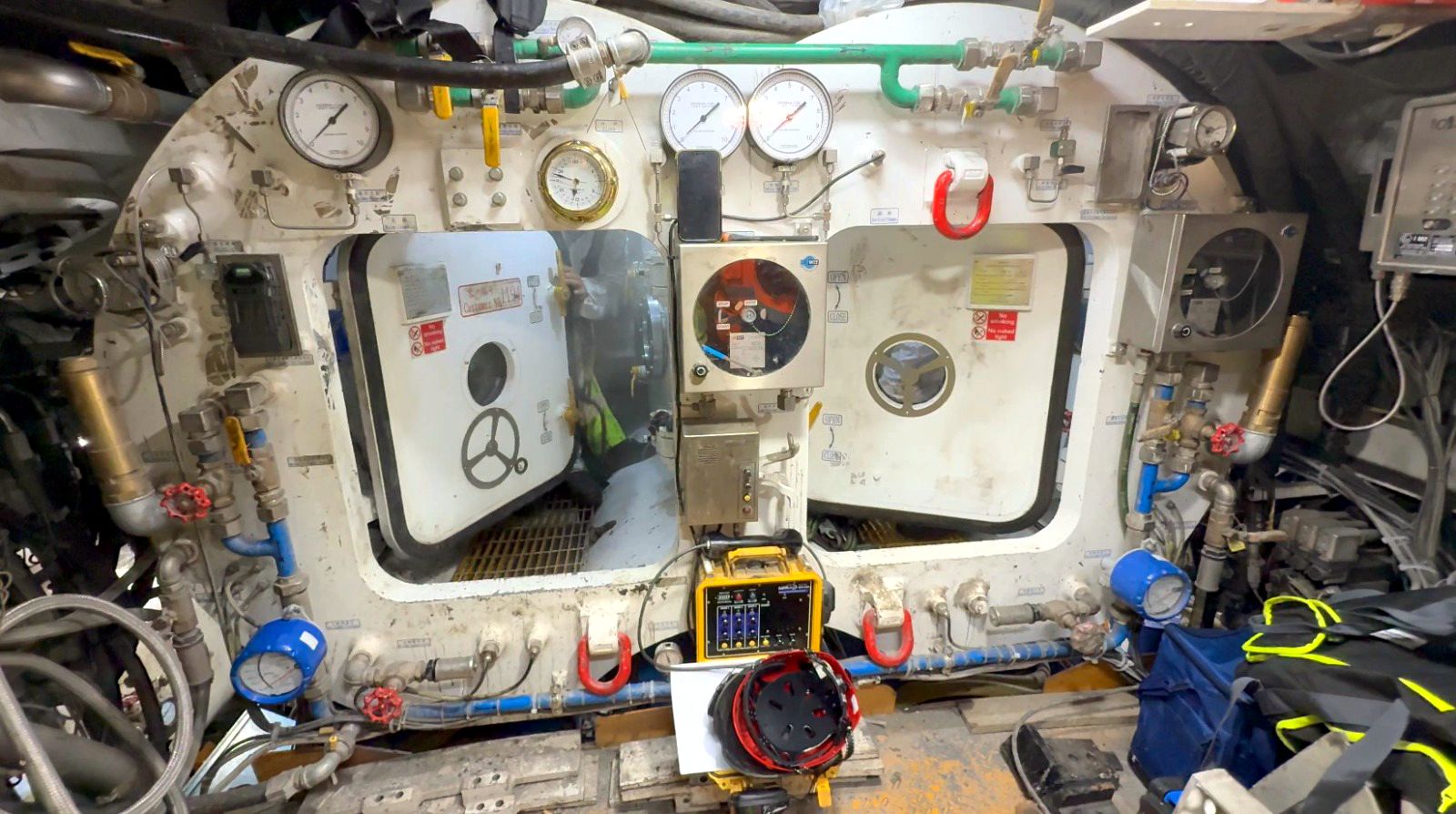
One of the most fascinating, yet complex, aspects of TBM tunnelling is hyperbaric excavation, used to stabilise unstable ground conditions through pressurisation.
The TBM is put in EPB (Earth Pressure Balance) mode to maintain the pressure and prevent the rock face from collapsing, ensuring safe access to the excavation chamber. Compressed air is introduced to stabilise the excavation front, creating a pressure differential with the outside environment”. Strict protocols apply:
“A specialist hyperbaric doctor is in attendance at the site to conduct medical checks before entering the hyperbaric chamber. The workers access the excavation chamber at pressure through a system of hyperbaric chambers, where the pressure is gradually increased or decreased, like professional divers do.”
Entering the hyperbaric chamber
The threshold where everything changes.
Everything changes: sounds, body perception, even time.
Hyperbaric operating conditions are not constant but programmed: “On average, this takes place every 300 metres, although the frequency depends on maintenance needs, which themselves depend on the hardness of the rock through which the TBM advances.”
Access and exit time is approximately 40 minutes. Maximum exposure time is strictly regulated, by means of charts, as are the compression and decompression times, and are followed by a mandatory 24-hour rest period.
Typically, three workers at a time enter the chamber: two perform the work while one provides assistance if necessary. A full work procedure may last four to five hours.
Working conditions are demanding: “Pressure is physically taxing and moving is difficult. Workers react in different ways, some feel cold rather than warm when leaving the tunnel face and returning to a normal environment.”
Strict safety rules apply: no matches, mobile phones, electronic watches or pressurised containers are permitted.
Safety is an absolute priority: there is a specialist hyperbaric doctor in attendance who checks every person going in. “People with high blood pressure are not allowed in. Even a simple nick from shaving can become dangerous in pressure conditions.”
All stages take place in the presence of the hyperbaric doctor and the first-aid and fire-fighting staff. If an injured person needs to be removed, a special (retractable) stretcher is brought inside the hyperbaric chamber; once outside the chamber, the injured person is then transported to the rear of the TBM on a spinal board, prior to being carried by means of a vehicle to the surface.
“It’s a job that puts you to the test, but it also makes you realise just how far the human body can go.”
Life in the tunnels: technology and humanity
Maintenance—particularly at the cutterhead—is among the most complex operations. The cutterhead represents the leading edge of the TBM and the furthest point of excavation.
What are the main reasons for periodically accessing the cutterhead?
“We access the hyperbaric chamber primarily to replace the cutting tools or discs, some weighing up to 365 kg. These are transported from outside through parallel hyperbaric chambers for the materials equipped with ad hoc sleds.”
Working at heights of up to 10 metres in confined spaces requires full coordination with safety personnel and the use of individual and collective fall protection systems. In difficult conditions, a full replacement of approximately 60 tools may take several weeks.
If we were to look inside a tunnel through your eyes, what would we see?
At the tunnel entrance, a digital counter displays the number of personnel currently working underground. In some cases, simpler but equally effective systems are used to count the personnel: when entering the tunnel, the workers remove their personal badges/keyrings from a holder, so that you can know at any time how many workers are inside by counting the missing badges.
Inside the tunnel, you can either walk or catch a van, during which you can get lost in your thoughts. The place is quiet, which can make you aware of the inherent risks of underground tunnelling work.
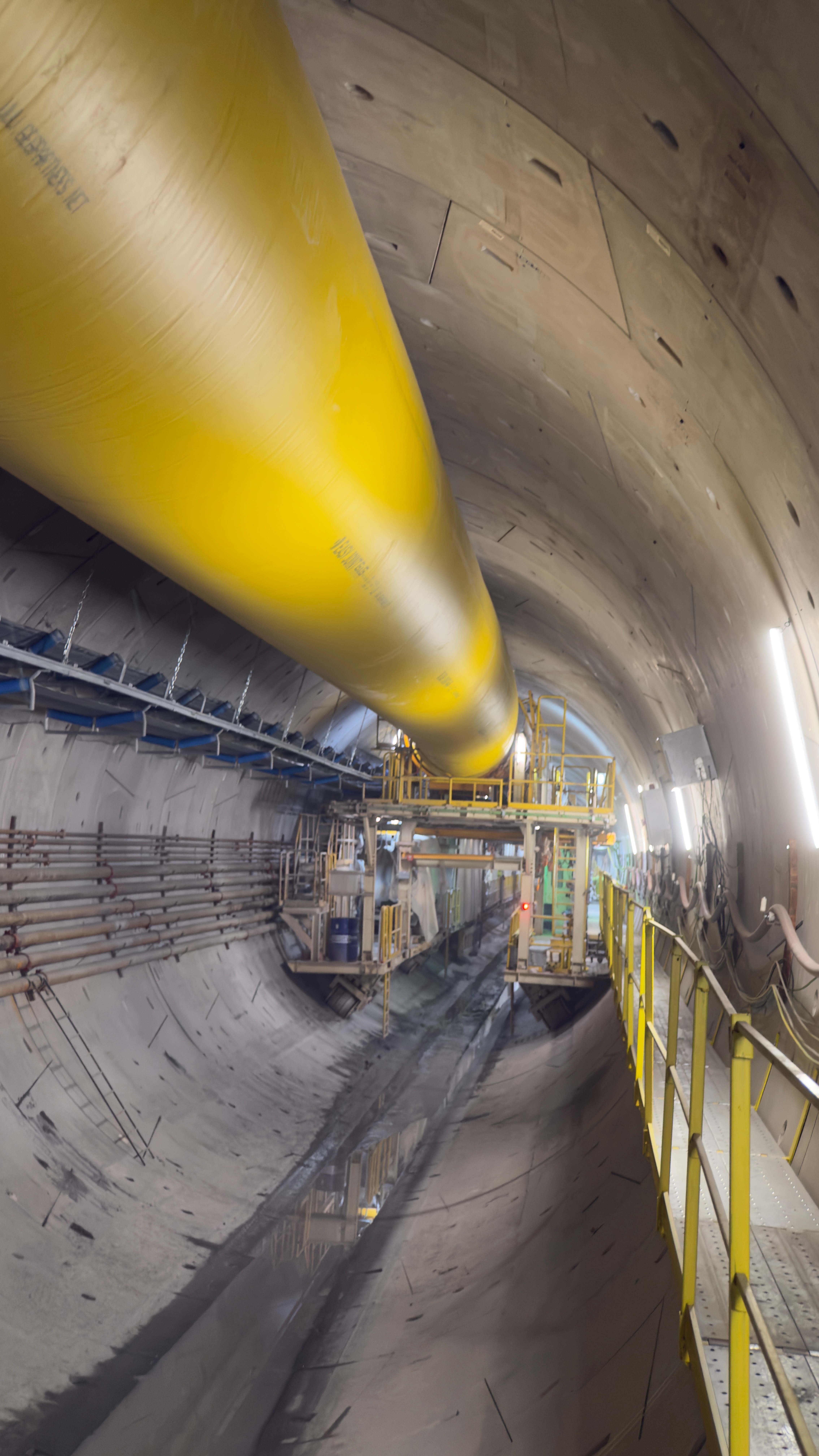
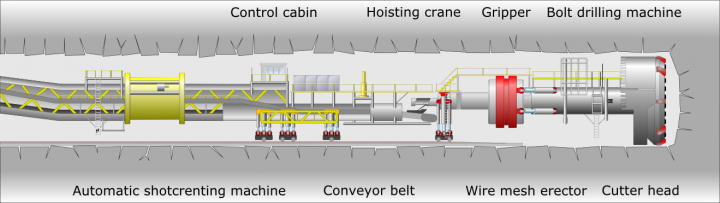
After a short while, depending on how far the TBM has progressed, you see the TBM trailing gear, with the first one also used to carry the personnel out of the tunnel in an emergency.
Stories and perceptions from the construction site
With adequate lighting, underground work does not negatively affect morale: “Lighting standards are met, and no one is required to work if they suffer from claustrophobia or other specific fear-related problems.” However, time perception changes: “Hours can go by without even noticing.”
A life spent tunnelling in silence
Tunnel life, as described by Di Stefano, is told as an experience marked by effort, precision, strict procedures, and a strong sense of humanity expressed through small daily gestures and respect for the TBM itself—maintained with care by the crews throughout the excavation.
The defining element remains silence: the silence perceived at the surface while work continues deep below, but also the dignity, expertise and dedication of the workers, which is often ignored or not adequately appreciated and on which these large infrastructure projects are built.
Final reflections
A TBM is not merely a machine—it becomes a “home” for the engineers and workers who livein it day and night. Visitors are welcomed as guests entering their home.
A strong sense of belonging emerges, combining the demands of the work with the human dimension of the people working there.
“Time flows differently”—and within that altered rhythm emerge sacrifice, cooperation, technical expertise, and the quiet resolve of those who face the unknown underground, every day …
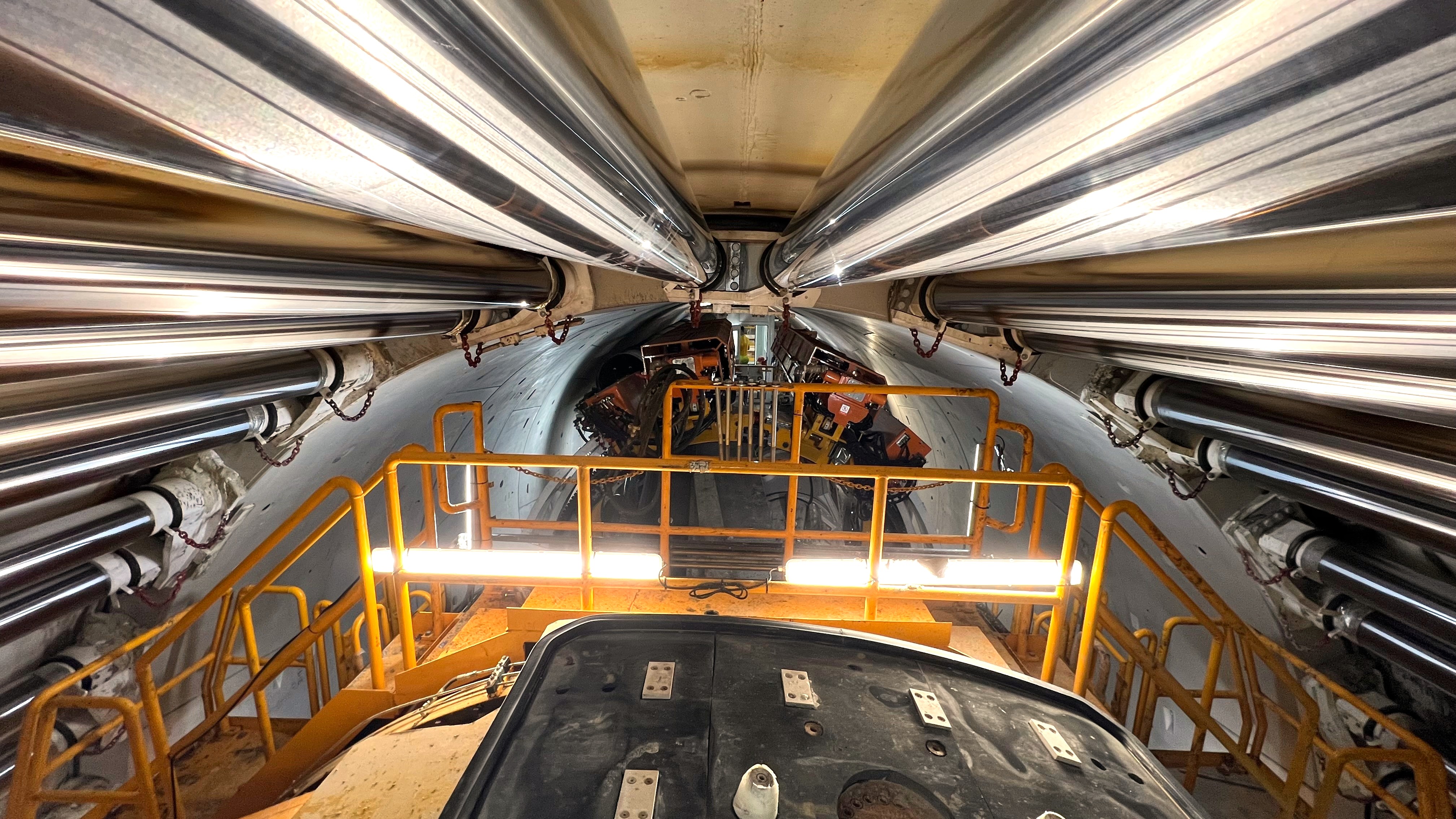
Photo credit: Giovanni Di Stefano, FS Engineering