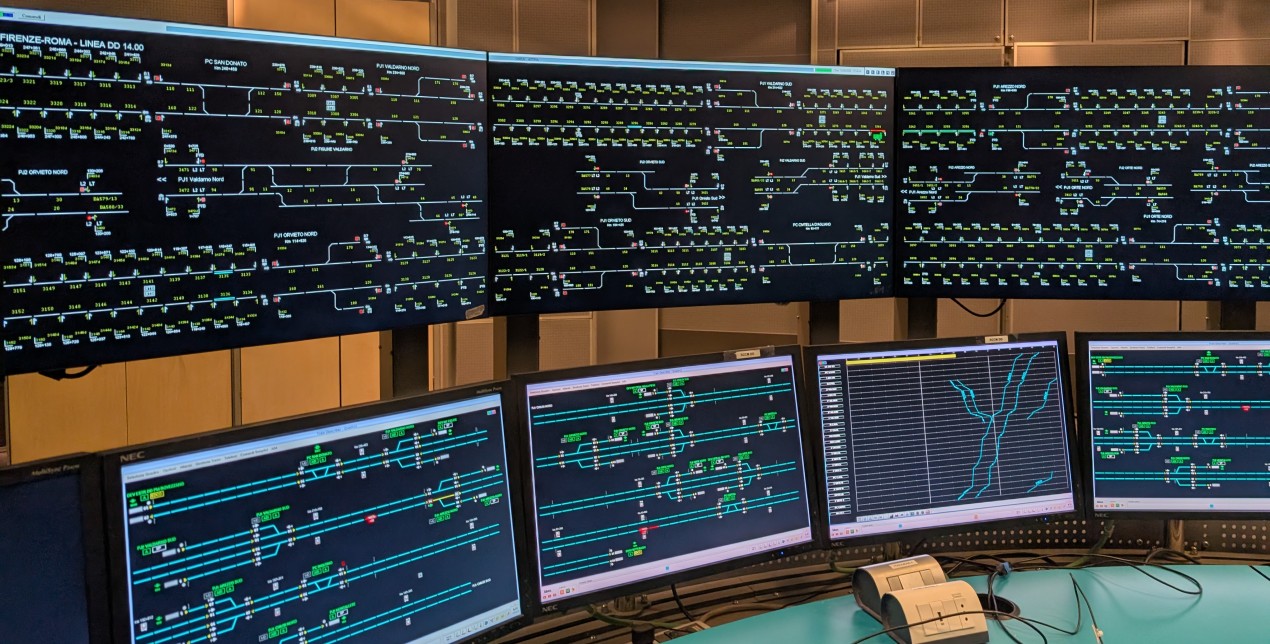
The ERTMS system now fully operational on the Rome–Florence high-speed line
The technological upgrade of the entire high-speed line is now operation following the completion of the final section between Orvieto Sud and Settebagni
Florence, 12 April 2026
A further milestone for innovating the Italian rail network: the third and final segment of the Rome–Florence high-speed line is now equipped with ERTMS (European Railway Traffic Management System) technology, the most advanced European train control technology for ensuring superior levels of safety, punctuality and operational efficiency.
FS Engineering and Rete Ferroviaria Italiana (RFI) finalised the installation of the ERTMS system on the 88-kilometre Orvieto Sud-Settebagni section. The project completes the technological overhaul of the “Direttissima” high-speed line, a programme launched in May 2017 and delivered in three stages: Phase A (Rovezzano–Arezzo Sud) launched in December 2020, Phase B (Arezzo Sud–Orvieto Sud, 85 km) launched in December 2022, and today’s final activation Phase C (Orvieto Sud-Settebagni).
The commissioning was carried out over an extended operational period, from 23:00 on Friday 10 April to 15:00 on Sunday 12 April, involving 300 personnel, including from FS Italiane Group and partner contractors. Of these, around 250 worked directly along the line and at the Central Control Centre, whilst around 50 provided remote support, ensuring continuous monitoring of all operational phases. Supported by an approximately €150 million NRRP-funded investment, the entire 240 kilometre Rome–Florence HS line now joins Italy’s over 700-kilometre network of high-speed lines already utilising ERTMS technology, paving the way for seamless Europe-wide interoperability.
RFI’s "ERTMS Accelerated Plan" aims to deploy the system across the entire 16,000-kilometer national network by 2042. This progress was bolstered by two European tenders—funded by the NRRP—designed to equip 2,785 kilometres of track with ERTMS by June 2026.
For FS Engineering, completing this project is a strategic milestone. By leading the design, supervision, and project management, the company has consolidated its role as a driver of innovation and sustainability. This achievement directly contributes to European interoperability and the development of a more efficient, competitive rail system.