October 25 1984
Italferr, now known as FS Engineering, was founded with the mission of promoting the excellence of Italian railway engineering on the domestic and international markets, in support of the country’s infrastructure development.
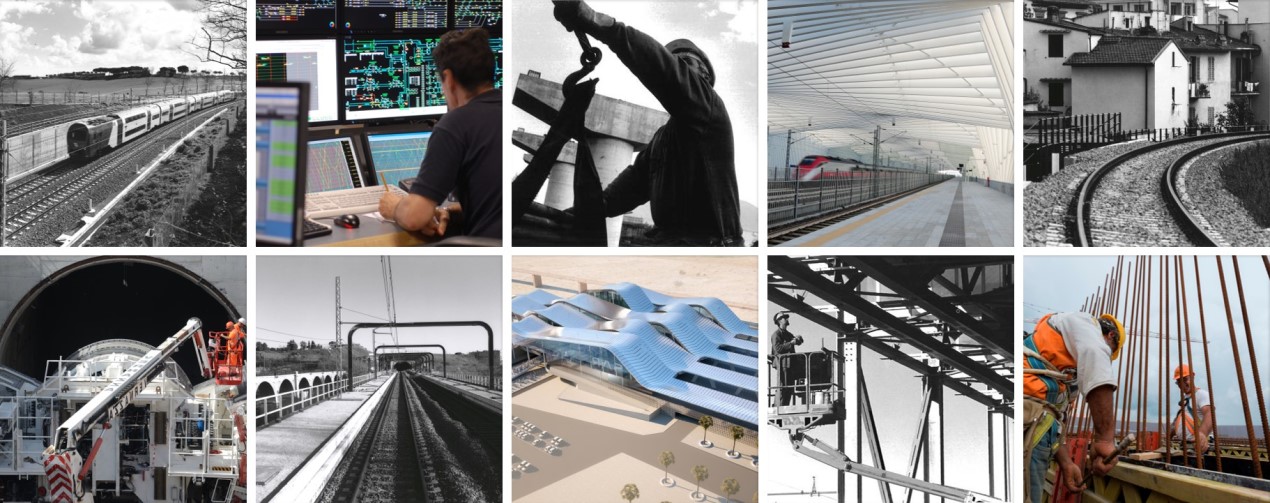
Italferr, now known as FS Engineering, was founded with the mission of promoting the excellence of Italian railway engineering on the domestic and international markets, in support of the country’s infrastructure development.
Fifteen years after its foundation, Italferr took on a leading role in the Italian infrastructure system, becoming the country’s leading contracting authority. It played a key role in the most significant acceleration of railway investment ever seen in Italy, contributing to the design of the major projects identified by the ‘Legge Obiettivo’ law. The growing complexity of the projects encouraged the introduction of innovative technologies, bolstered by the launch of the new railway traffic command and control system.
The construction of the High-Speed/High-Capacity (HS/HC) railway system was now in full swing. Italferr demonstrated its expertise in the design of complex projects, the commissioning of modern technological systems at railway hubs, and the construction of strategic crossings, including Bologna–Florence and Naples–Salerno. Alongside the development of the HS/HC lines, new maintenance centres for the high-speed network were built, including the Multipurpose Dynamic Test Facility in Naples, and Italy’s largest ACC (Computerised Central Interlocking system) was commissioned in Pisa.
The experience gained in Italy enabled the company to secure contracts abroad, including comprehensive transport plans, technical assistance to institutions and railway operators, and the design of maintenance facilities in Europe, the Middle East, Asia and Latin America.
The high-speed and high-capacity rail system profoundly transformed the Italian rail network, with over 1,000 km of lines connecting the country along the Turin–Salerno axis, with the opening of new sections and strategic hubs. At the same time, Italferr began strengthening its commitment to environmental protection by developing innovative methods for measuring CO₂ emissions as early as the design phase. These activities were recognised internationally with a Merit Award for integrated management systems and climate footprint assessment. The international portfolio was further consolidated with new projects in Africa and Eastern Europe.
The high-speed and high-capacity rail network was further enhanced by landmark infrastructure projects: Roma Tiburtina, Torino Porta Susa, Reggio Emilia high-speed station, the Bologna Bypass and the start of work on the Napoli Afragola and Firenze high-speed stations. During this period, major strategic national and international corridors also started taking shape, including the Turin–Lyon line and the Brenner Base Tunnel. In 2014, Italferr was assigned the works supervision role for EXPO Milano 2015, an international event dedicated to sustainability and innovation.
Italferr consolidated its role in serving the Italian national infrastructure system, working on major strategic projects and contributing to the establishment of increasingly high and uniform safety standards across the national network. Among its most significant projects was the Works supervision and Health & Safety supervision of the Terzo Valico dei Giovi project consisting in a key infrastructure link between the Mediterranean and Northern Europe. Shortly after, the company was among the first in Italy to adopt and promote BIM methodology in infrastructure projects, strengthening its leadership in the sector’s digital transformation.
In 2018, Italferr played a leading role in the detailed design of the new bridge over the Polcevera that was completed in record time and which has become a symbol of integrated engineering and resilience.
Despite the pandemic, Italferr recorded growth in terms of turnover, order book and international presence, confirming the robustness of its operating model and the value of the expertise it had developed.
With the launch of the FS Group’s Infrastructure Division, Italferr strengthened its role in the major strategic projects of the NRRP, with a particular focus on routes in Southern Italy and the implementation of the ERTMS system. At the same time, the company developed advanced Digital Twin solutions, which were also applied to the preservation of historical heritage, as in the internationally acclaimed project for St Peter’s Basilica.
Work continued on major national projects: the Florence High-Speed Rail Bypass, Naples–Bari, Palermo–Catania–Messina, Salerno–Reggio Calabria, Milan–Venice and Brescia–Verona. Internationally, projects such as Rail Baltica and the Anji Khad Bridge in India strengthened Italferr’s global position. In 2024, the Anji Khad project received the ENR Global Best Projects – Award of Merit, in recognition of engineering excellence and technological innovation. 2025 consolidated the company’s role as an international benchmark for complex infrastructure, sustainability and digitalisation.
2026 marks the start of a new phase: Italferr evolves into FS Engineering.
The new name represents the culmination of over forty years of growth and the start of a renewed industrial vision within the Ferrovie dello Stato Italiane Group. With FS Engineering, engineering becomes a strategic driver of innovation, digitalisation and competitiveness, strengthening the company’s role as a technical and technological hub serving the country and as a leading player in the international markets for major infrastructure projects.