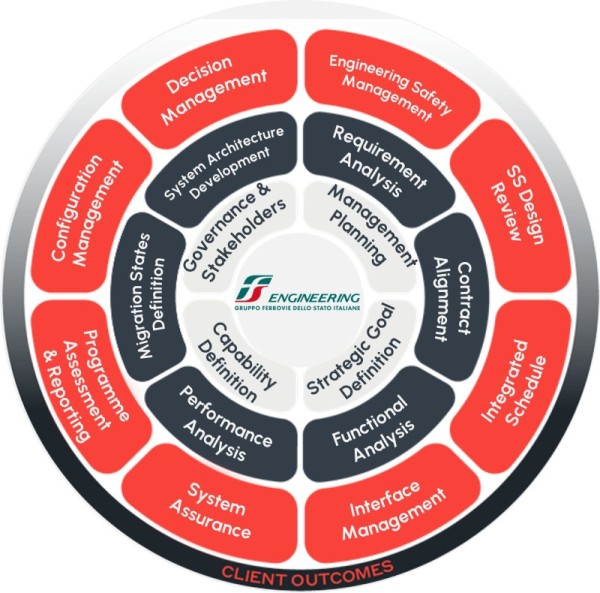
FS Engineering adopts a holistic approach to design, focused on the project’s operational targets and based on the application of processes compliant with the EN15288 international standard. This model effectively supports Design Management, ensuring clarity for the client and full consistency of project requirements.
Requirements Management
Requirements management is carried out in a multidisciplinary context across all project phases by defining a structured, comprehensive, and traceable baseline to ensure shared visibility and ongoing information control, while also fostering transparent change management for clients.
This approach enables a systematic view across all disciplines and full integration with interface management (Project Understanding), improving overall project definition. The requirements are clear, validated, and ready for use in the testing and construction phases (Handover to Contractors), facilitating an effective handover to contractors. Furthermore, the model ensures alignment with RAMS standards and Hazard Analysis activities (Safety & Compliance) to support safety and compliance.
The structure allows for rapid assessment of the impact of variations, reducing rework and optimising issue and change management processes, as well as verification and validation (V&V) activities.
Interface Management
Interface management is a core discipline in highly integrated projects. FS Engineering ensures the management of both internal and external interfaces—spanning from the straightforward to the highly complex—by employing a structured, risk-based approach.
Interfaces are prioritised according to their criticality. Particular attention is focused on those characterised by a high degree of multi-disciplinary coordination, multiple stakeholder environments, impacts on safety and operations, and high integration risks.
The process is supported by dedicated tools, including interface matrices and registers, alongside specific technical documentation such as Interface Control Documents (ICDs). This framework ensures precise, traceable, and collaborative control throughout the project lifecycle.