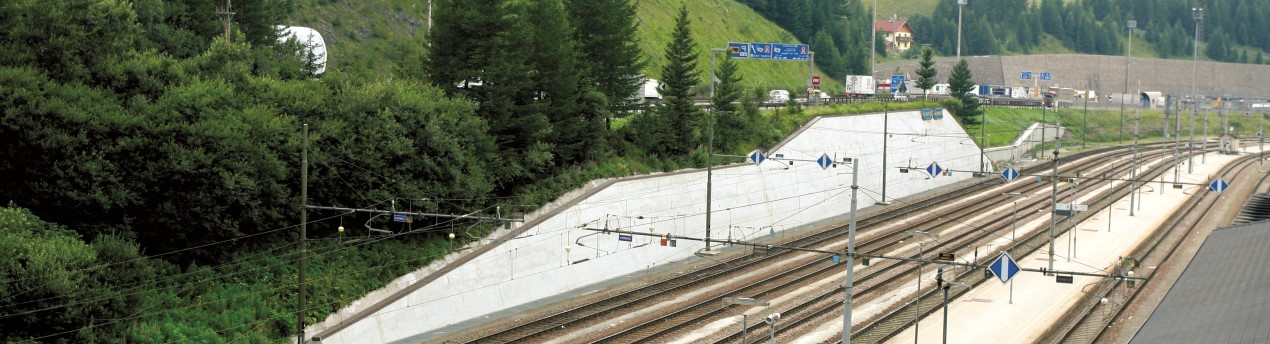
The project
FS Engineering is involved in the implementation of the Brenner Access Project, aimed at upgrading the trans-European transport network's (TEN-T) Scandinavian–Mediterranean Core Corridor. This strategic European axis links Helsinki and Valletta over a total length of 9,400 km, crossing Central Europe, along the Tyrrhenian coast, and touching the major cities of Sicily.
The Alpine section of the corridor comprises the Munich–Innsbruck Northern Access Line, the Brenner Base Tunnel, and the Fortezza–Verona Southern Access Line. The Northern Access Line and the Brenner Base Tunnel are cross-border projects, whilst the Southern Access Line runs entirely along the Isarco and Adige valleys in Italy.
The Brenner Base Tunnel and the approach lines
The Brenner Base Tunnel will extend for approximately 55 km between the stations at Fortezza, in Italy, and Innsbruck, in Austria, joining the Innsbruck ring road – which is also tunnelled – underground, for a total length of approximately 64 km. The southern approach Line, running between Fortezza (BZ) and Verona (VR), is approximately 180 km long overall and involves the quadrupling of the existing two legacy tracks, allowing for a clear separation of traffic flows. The northern side of the project is represented by Lot 1 Fortezza–Ponte Gardena, which runs predominantly through tunnels over a length of 22.5 km.
Benefits
The new infrastructure will enable the separation of freight and passenger traffic flows and, in the latter case, between long-distance and local services, with significant benefits in terms of service regularity and efficiency.
Local public transport will be able to operate on the legacy line more efficiently, quickly, and at regular intervals. Meanwhile, on the new underground route between Fortezza and Innsbruck—which is approximately 20 km shorter than the legacy line—the time currently required for changing traction due to the different power supply systems in Italy and Austria will be eliminated. This will enable journey times to be reduced by around two-thirds for the fastest trains, falling from the current 75 minutes to around 25 minutes.
For freight traffic, the infrastructure will enable a significant increase in volumes entering from the north towards the Verona hub, with major benefits for the Quadrante Europa road/rail intermodal terminal, which is playing an increasingly central role in the Italian and European logistics system. The area represents a strategic intersection between two trans-European transport network (TEN-T) Core Corridors—the Scandinavian–Mediterranean and the Mediterranean—as well as between the Brenner (North–South) and Serenissima (West–East) motorway routes.
| KEY PROJECT FIGURES |
| Line length: 15 km |
| Design maximum speed: 200 km/h |
| Electrification: 3 kV |
| Signalling system: ERTMS Level 2 |
| Axle load: D4 |
| Gauge: P/C80 |