BRESCIA EST-VERONA SECTION
A strategic high-speed rail link connecting Northern Italy and Europe
The project
The Brescia East–Verona section forms a vital part of the new Milan–Verona railway line, representing an integral link in the Turin–Milan–Venice high-speed/high-capacity corridor and the wider European rail network, connecting Lyon, Turin, Milan, Venice, Trieste, and Ljubljana. This project stands as a strategic infrastructure for the east-west axis of the European rail network. It is identified as a cornerstone of Italy's national network within the General Transport Plan, serving as a core component of the Mid-Po Valley cross-regional corridor. Furthermore, the project is a flagship initiative of the Mediterranean Corridor within the trans-European TEN-T network, which connects the Iberian Peninsula to Eastern Europe via southern France, northern Italy, Slovenia, and Croatia.
Strategic context
The construction of the Brescia Est–Verona high-speed/high-capacity section is a flagship project funded by Italy’s National Recovery and Resilience Plan (NRRP). It contributes significantly to enhancing both the capacity and efficiency of the national and European rail systems. Commissioned by Rete Ferroviaria Italiana, the project is an integral part of a broader network expansion program. Following the successful completion of civil engineering works, test runs began along the entire route in June 2026, keeping the project firmly on track for final technical acceptance and entry into service in early 2027.
The role of FS Engineering
FS Engineering is responsible for project management and overall supervision, while the construction work has been contracted to the CEPAV Due Consortium.
Route and geographical context
The new high-speed line extends for approximately 48 km, which includes a 2.2 km ‘Verona Merci’ interconnection to link seamlessly with the strategic Verona–Brennero route. To minimise environmental impact, the alignment runs parallel to the A4 motorway for approximately 30 km and sits adjacent to the Milan–Venice railway legacy line for a further 8 km. Spanning both the Lombardy and Veneto regions, the infrastructure crosses 11 municipalities in the provinces of Brescia and Verona, with a marginal section entering the province of Mantua for associated road works. The route begins near the Mazzano junction and extends to the Lugagnano junction, where it reconnects with the existing rail network. From an engineering perspective, the infrastructure features approximately 23.4 km of embankment, 16.8 km of tunnel, and 0.9 km of viaduct.
Engineering solutions and complex works
Among the most significant elements of the project are the two underpasses beneath the Brescia–Padua motorway, which were constructed without interrupting traffic flow and feature an average clearance of approximately 10 metres. The first underpass, in the municipality of Lonato del Garda, extends for about 400 metres and was built using mechanised excavation. A 10-metre-diameter Earth Pressure Balance Tunnel Boring Machine (EPB TBM) was deployed to excavate and line the twin tunnel tubes with prefabricated segments. Each of these tubes is approximately 4.8 km long, and the team achieved impressive advance rates of up to 30 metres per day. The second underpass, in the municipality of Sommacampagna, was constructed using conventional excavation methods. This work followed extensive ground stabilisation via jet grouting and required the temporary diversion of the motorway lanes, which successfully avoided any interference with the operational carriageway.
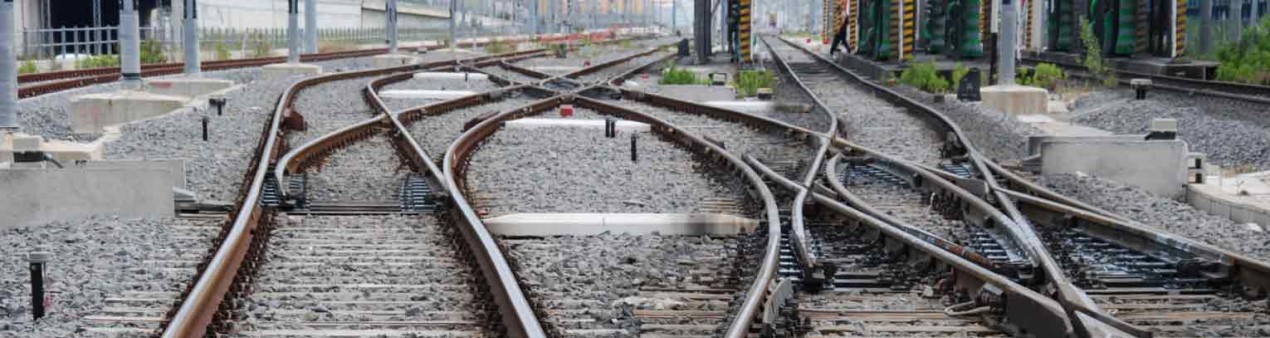
The civil engineering works are almost complete, with teams currently focusing on the installation of technical equipment and railway trackwork. These operations involve spreading ballast and laying sleepers and rails using a specialised track-laying train. Having commenced in April 2025, these activities have so far resulted in the successful installation of approximately 17 km of even-numbered track and 17 km of odd-numbered track.
| KEY FIGURES OF THE BRESCIA EST–VERONA SECTION |
| Total length: 47.6 km |
| Maximum design speed: 250 km/h |
| Length of viaduct sections: 0.9 km |
| Length of tunnel sections: 16.8 km |
| Maximum gradient: 12 ‰ |
| Minimum curve radius: 5,200 m |
| Electrification: 3 kV |
| Signalling system: ERTMS Level 2 |