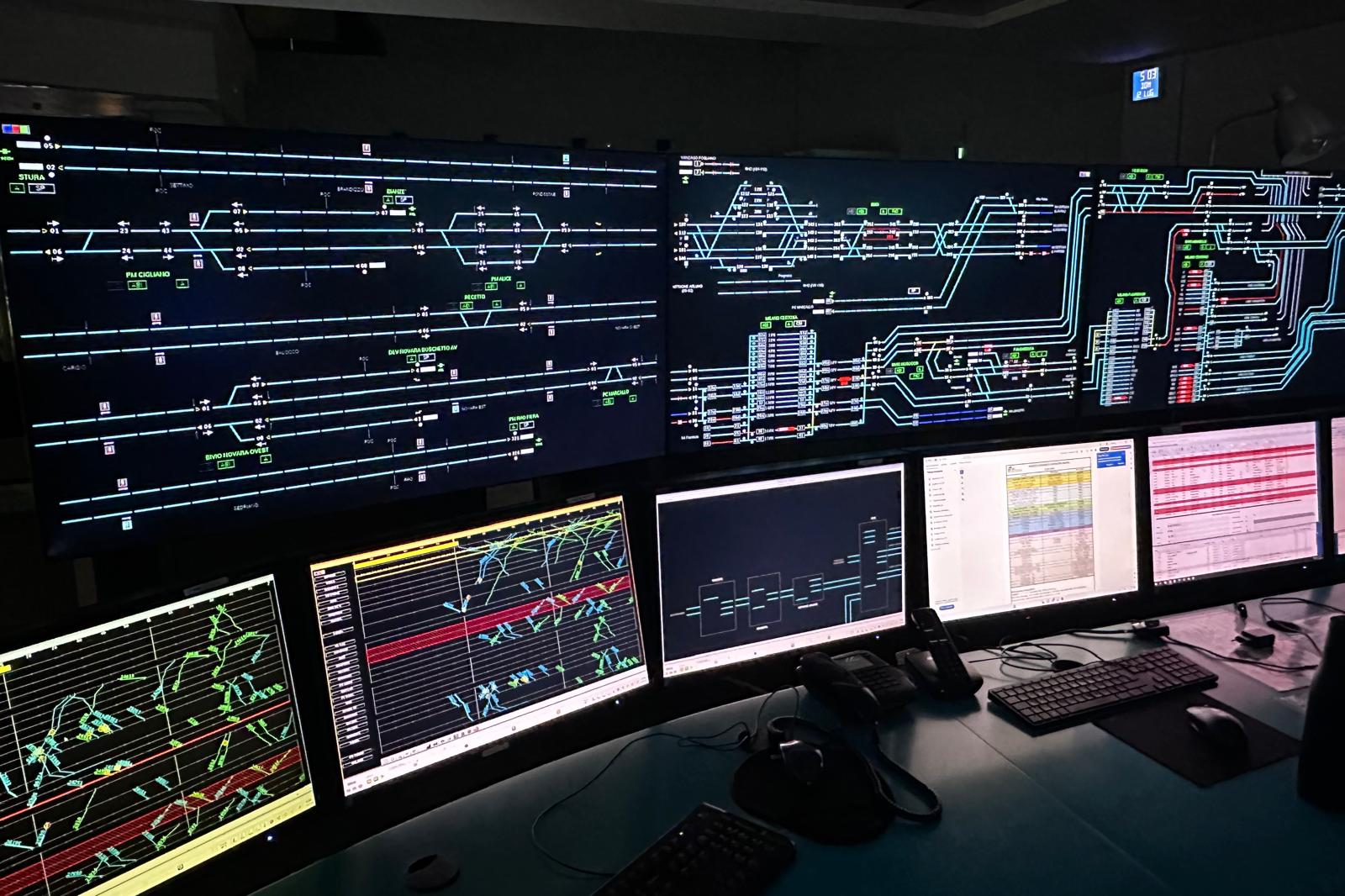
The heart of railway operations looks to the future
Technological Upgrade of the Milan Greco Multistation Command and Control System Completed
Milan, 16 July 2026
The revamping project for the Multistation Command and Control System (SCCM) at the Milan Greco Pirelli Multistation Control Centre, one of the key hubs for managing railway traffic across Italy, has been successfully completed. With the commissioning of the second and final phase of the project, following the completion of the first phase in November 2025, an important technological innovation programme aimed at enhancing the efficiency and reliability of the Italian railway network’s supervision and control systems has now been brought to completion.
The project enabled the migration of the entire system to a new-generation virtualized platform that is modular, scalable, and compliant with the latest technological solutions for railway traffic command and control.
The second phase involved upgrading traffic management systems along the Turin–Padua corridor, the Cremona Area CTC, the Verona Node SCCM, the Torreberetti CTC, and the Brescia SSA. The intervention also included the renewal of interfaces with the main operational systems and the consolidation of connections with the control and supervision centres linked to the Central Operations Centre. The adopted solution allows for more efficient management of technological resources, simplified maintenance activities, and enhanced operational resilience of the central railway traffic control systems.
This was a collaborative effort that saw FS Engineering, together with Rete Ferroviaria Italiana (RFI) and contractor Hitachi Rail, working to deliver a technological infrastructure capable of meeting both the current and future needs of the railway network.
With the completion of the project, the Milan Greco Multistation Control Centre now benefits from a more modern, reliable supervision system, ready to support the ongoing evolution of the railway network, including future high-speed rail extensions on the Brescia–Verona and Verona–Vicenza sections, as well as additional lines connected to the Milan Greco hub.
This achievement confirms the value of technological innovation as a strategic driver for the safety, efficiency, and sustainability of railway mobility.