
The project forms part of the wider programme to upgrade the Palermo–Catania railway line, along the Fiumetorto–Bicocca section (178 km), aimed at increasing the capacity of the existing single-track line and raising speeds to 200 km/h.
The project will enable a gradual reduction in journey times and a significant increase in transport capacity for both passenger and freight traffic, ensuring the operation of freight trains meeting European standards.
Lot 4b involves the construction designs and construction of a new high-speed track along the Nuova Enna–Dittaino section, which runs entirely on a new alignment separate from the legacy line, between the stations of Enna and Dittaino.
Use of 5D models for cost accounting
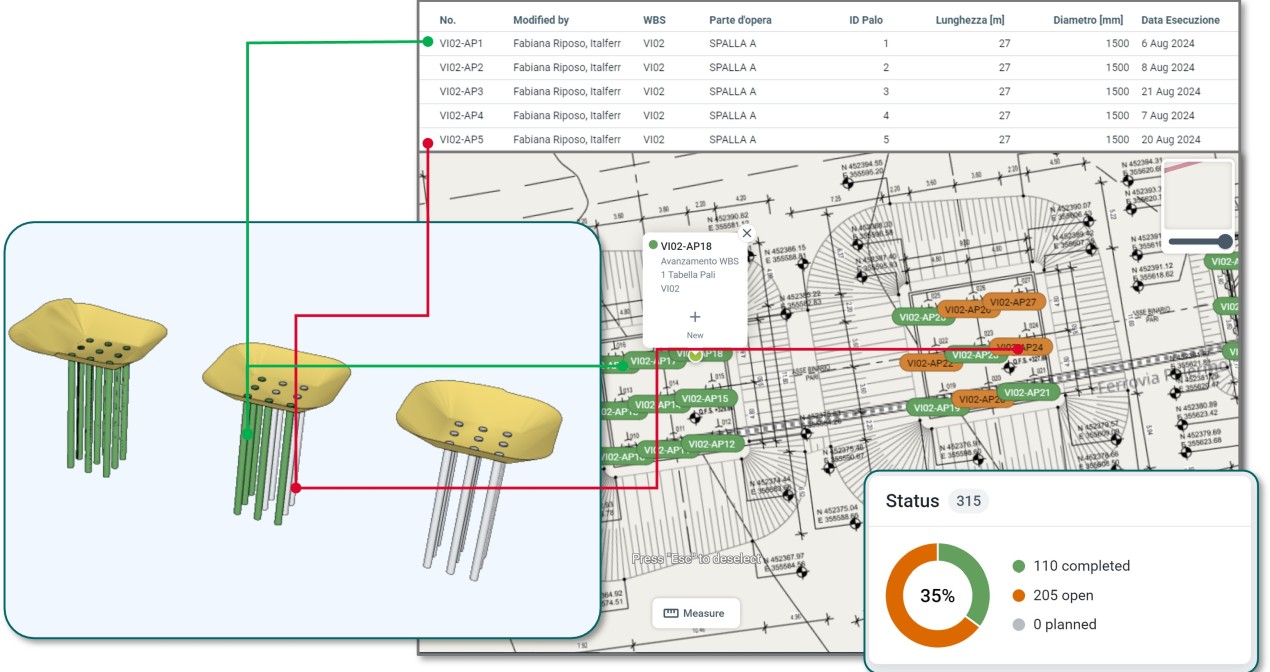
The use of Property Sets (pSets) for cost accounting purposes enables the development of advanced and highly informative IFC models to support project management and site supervision activities. The digital models allow for the integrated monitoring of construction progress, linking each design component to the relevant WBS, quantities, costs, and construction times.
Thanks to the use of collaborative platforms and Common Data Environments (CDEs), information is always up to date and easily accessible, even directly on site via mobile devices, promoting more transparent, fast, and efficient processes.
The integration of BIM models, project accounting and 4D/5D simulations also enables precise verification of the work carried out, through continuous comparison between the data reported by the contractor and the actual construction progress.
This approach helps to improve quality control, timeframes, and costs, reducing errors, clashes and the need for repetitive on-site checks.
New Salerno–Reggio Calabria HS rail line
Battipaglia–Romagnano Lot 1A (NRRP)
Lot 1A is the first operational section of the wider Battipaglia–Praia project and involves the construction of a new double-track railway line designed for a maximum speed of 300 km/h. The route, starting from Battipaglia, runs towards Romagnano, where it is scheduled to connect with the existing Battipaglia–Potenza line, before continuing through the Vallo di Diano. As part of this, a new station will be built at Buonabitacolo, before reaching Praia.
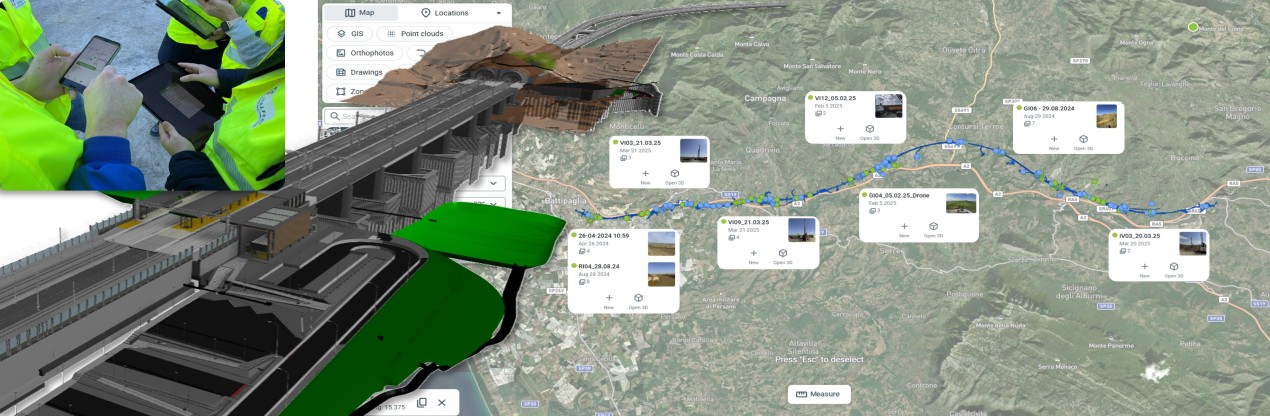
To support contract monitoring activities, the use of photographs, videos and 360° georeferenced images is a strategic element, enabling precise verification of the progress of works and continuous comparison with the information model. This approach also allows the project to be contextualised with regard to the actual situation at the construction sites at the time of acquisition, thus facilitating the timely and effective identification of any interferences and clashes.
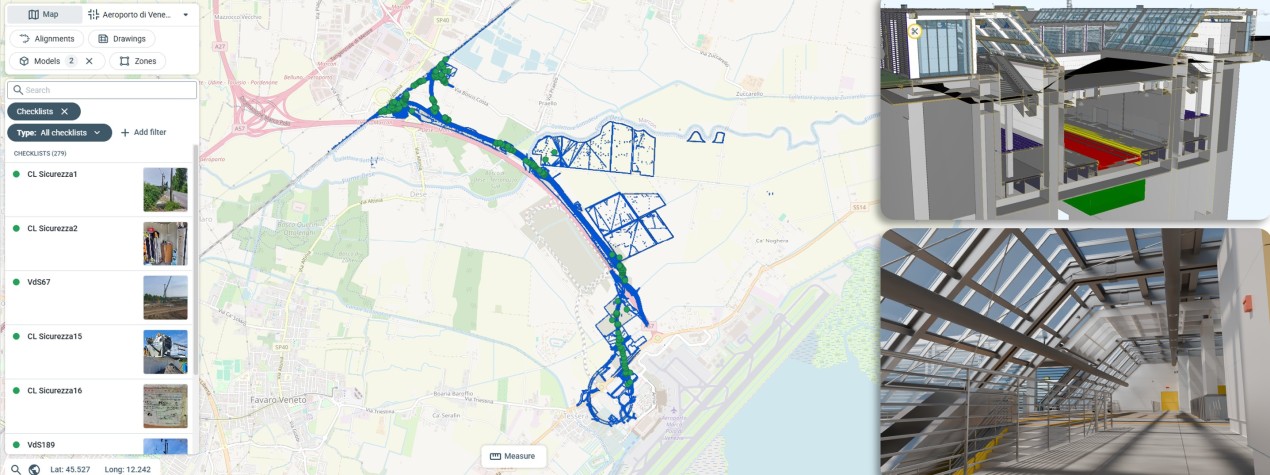
This project concerns the construction of an intermodal link between Marco Polo Airport and the national rail network, in line with European directives designed to promote a modal shift towards rail transport.
The route, approximately 8 km long, branches off from the legacy Venice–Trieste main line, which is double-track on the Venice side and single-track on the Trieste side, with points that can be negotiated at 60 km/h. The project also involves the construction of a new underground airport station.
The link will serve both long-distance and regional trains, helping to expand the catchment area of the rail network and the airport and strengthen integration between the various modes of transport.
A 360° digital construction site
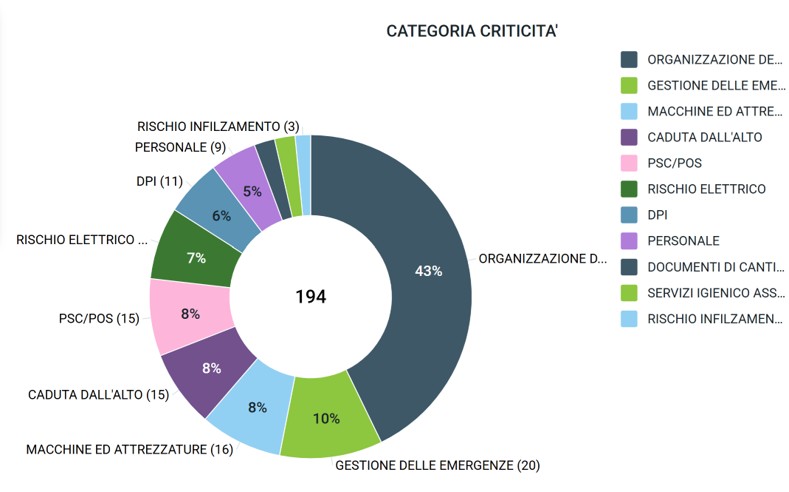
The digital approach to construction site supervision and management is based on the use of Common Data Environments (CDEs), a key tool for ensuring accurate, timely checks and maximum transparency in project and site management. CDE enables a swift comparison between the designs, the georeferenced models, and the completed works, facilitating continuous and integrated monitoring.
The implementation of real-time online reporting systems also ensures the traceability of ongoing and completed activities through immediate access to the history.
Georeferencing, extended to the construction site as a whole, enables each piece of information to be uniquely linked to the relevant Work Breakdown Structure (WBS), ensuring that all the documentation is easily accessible and searchable both on-site and remotely.